

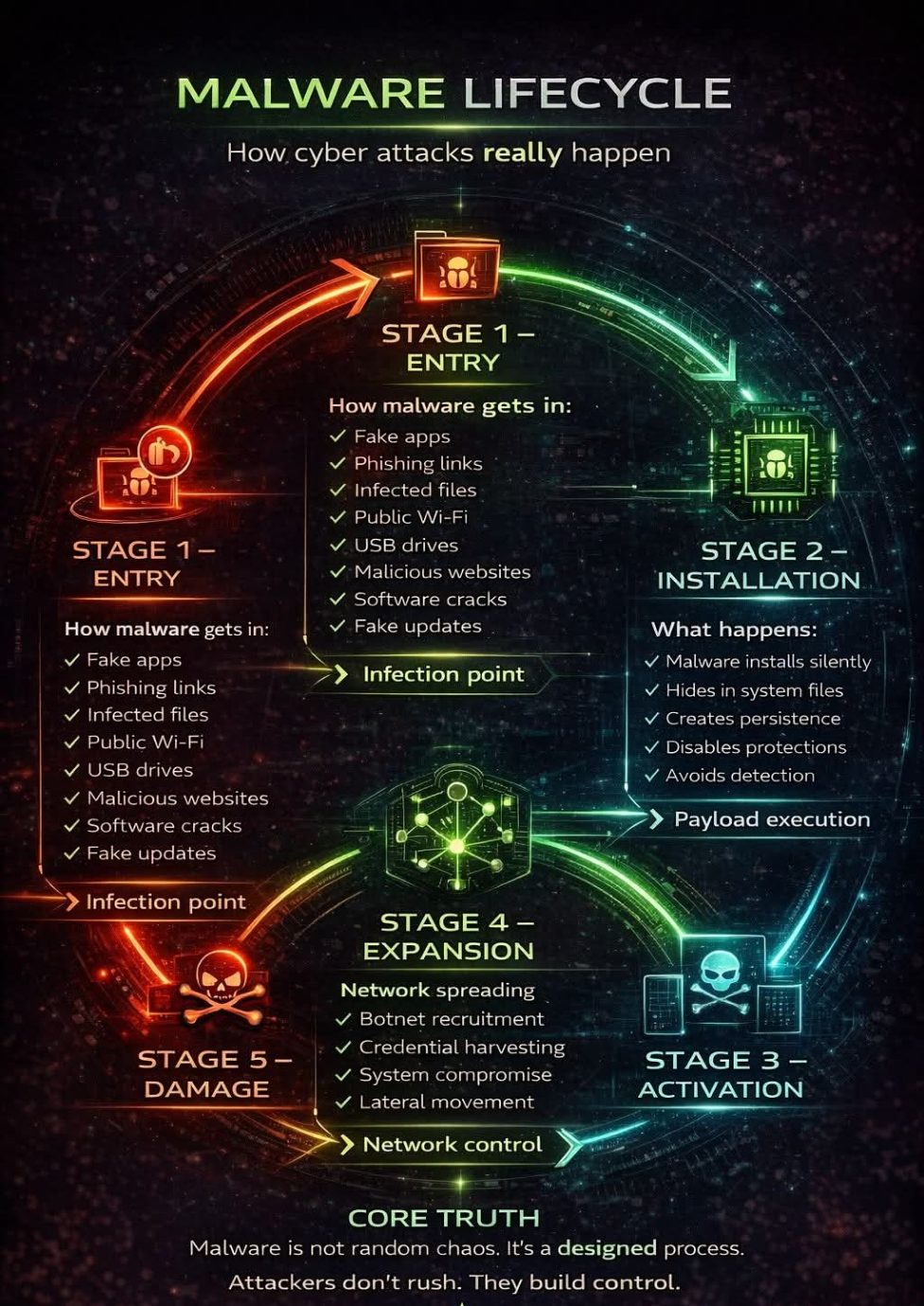
MALWARE LIFECYCLE
(FOR EDUCATIONAL PURPOSES ONLY)
How cyber attacks really happen
Most people think hacks are instant.
They’re not.
They follow a process.
🧬 STAGE 1 — ENTRY
How malware gets in:
Fake apps
Phishing links
Infected files
Public Wi-Fi
USB drives
Malicious websites
Software cracks
Fake updates
➡️ Infection point
🕳️ STAGE 2 — INSTALLATION
What happens:
Malware installs silently
Hides in system files
Creates persistence
Disables protections
Avoids detection
➡️ Establishing control
🧠 STAGE 3 — ACTIVATION
What it starts doing:
Steals data
Tracks activity
Spreads to other devices
Contacts command servers
Downloads more malware
➡️ Payload execution
🕸️ STAGE 4 — EXPANSION
How it grows:
Network spreading
Botnet recruitment
Credential harvesting
System compromise
Lateral movement
➡️ Network control
💀 STAGE 5 — DAMAGE
Final impact:
Data theft
Financial loss
Identity theft
Surveillance
System destruction
Service disruption
➡️ Real-world consequences
Malware is not random chaos.
It’s a designed process.
Attackers don’t rush.
They build control.
🛡️ HOW TO BREAK THE CYCLE
✔️ Updates
✔️ Firewalls
✔️ Secure DNS
✔️ Network security
✔️ Zero-trust mindset
✔️ App verification
✔️ User awareness
✔️ Monitoring tools

 314.860 SRY